
Johari window was developed by psychologist Joseph Luft and Harrington Ingham in 1955. It is a simple and useful tools that helps people better understand their relationship with themselves and others (Communication Theory, 2014).
The model consist of four quadrant, which are open self, blind self, hidden self and unknown self.
- Open Self: Traits that the subject and the peers are aware of
- Blind Self: Traits that the subject is unaware but the peers are aware of
- Hidden Self: Traits that the subject is aware of but the peers are unaware of
- Unknown Self: Traits that the subject and the peers are unaware of
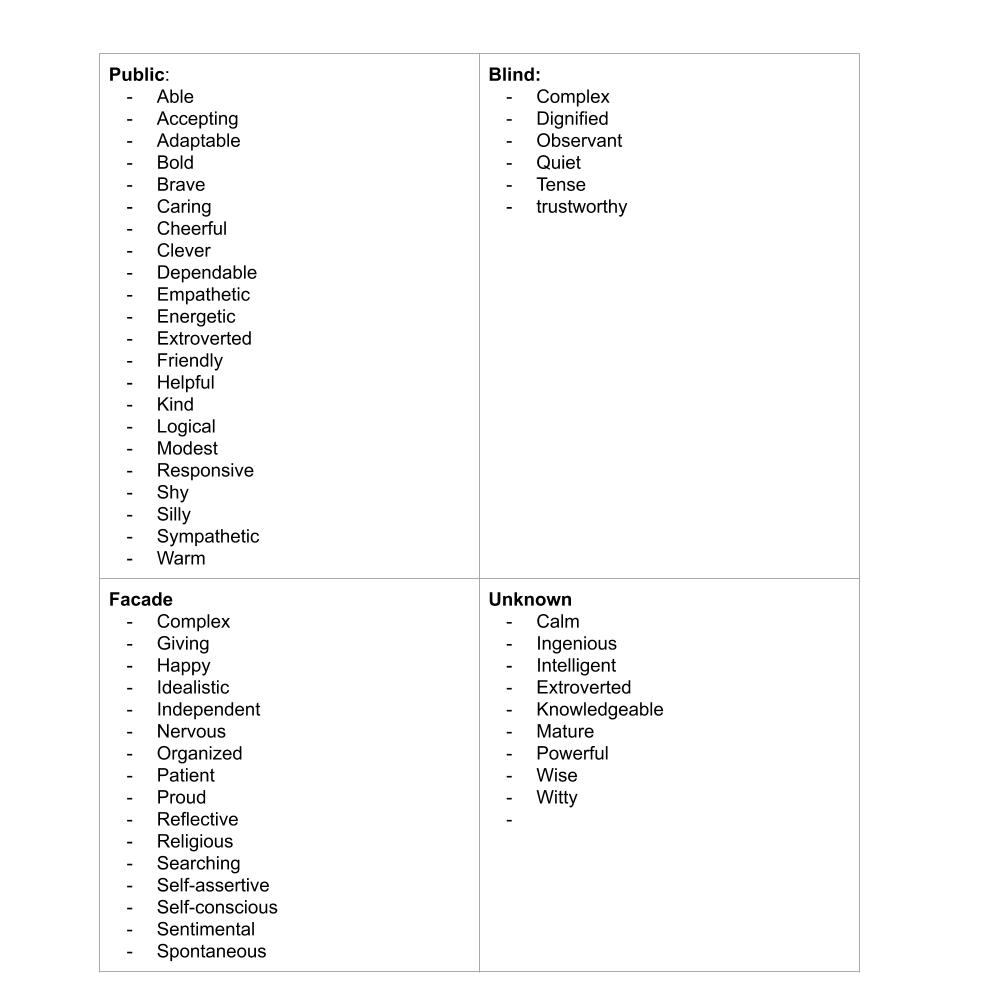
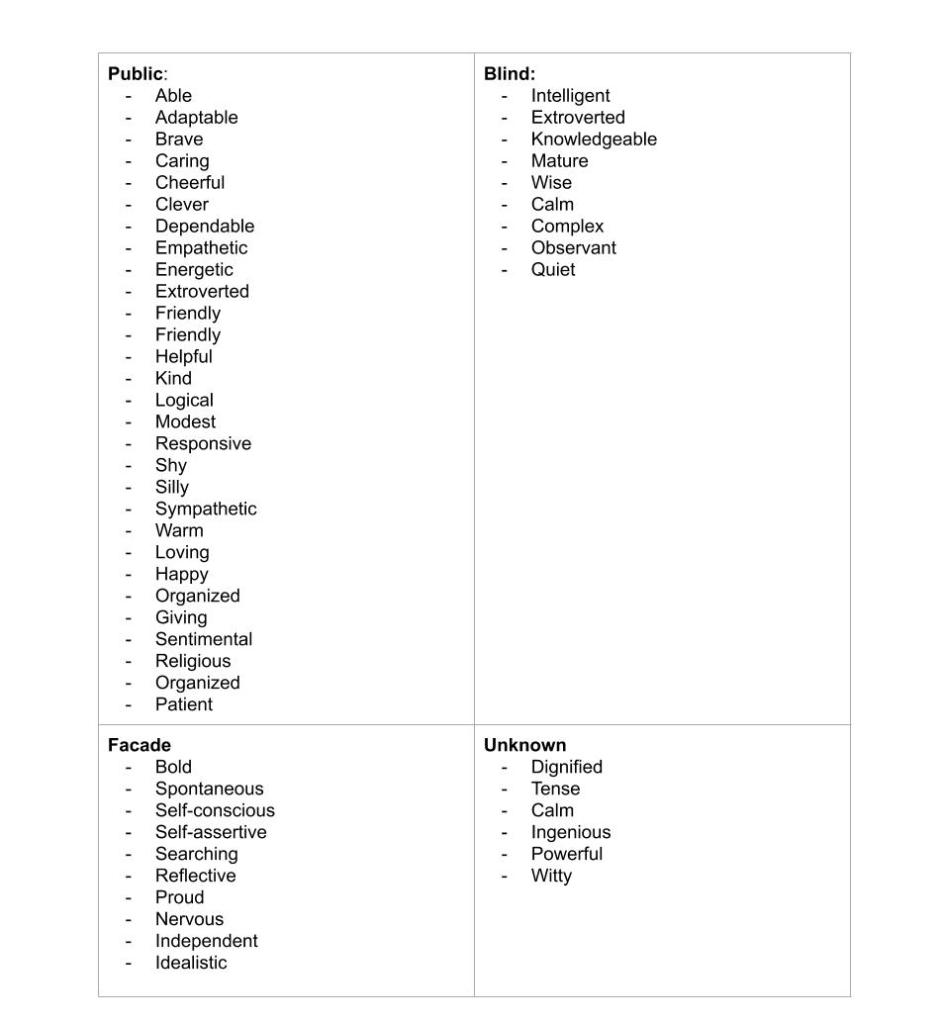
My Johari Window
Accuracy of Johari Window
The first table was made by Shi Jian who is my classmate in UOW-SIM, and I have known him for around a year. The second table was made by DanBee who is my girlfriend, and I have known her for around five years. Before both of them made the Johari Window, I thought that both table would look different due to the large difference in amount of time I have known both person. Despite knowing Shi Jian for shorter amount of time, he have managed to identify and acknowledge many of my traits that I was aware and unaware of. This tells me that there are many traits in Johari Window can be identified and acknowledge by others in short period of time. While some traits like nervous and religious may take longer period of time for others to notice, many traits like helpful, friendly and cheerful does not require long period of time for others to notice and acknowledge them. The Johari Window also allowed me notice trait that I was unaware of. I was not aware I was observant until Shi Jian and DanBee have told me that I was through the Johari Window
Based on the two tables, I can say Johari table is accurate to a certain extent. Both of the Johari Windows have successfully shown traits that I was aware of. Both tables have shown that many of the traits are in the same quadrants as the other table hence making them more consistence and reliable. However, as people act differently based on their emotions and the situations that they are in, I believe the model is accurate to a certain extent.

Surprise from perception by friends
Based on the results, I am not surprised as the results were similar to what I have imagined.

More self-awareness and your communication in a team
The results are very useful and helpful as it it allows the person to be aware of the traits that the person is unaware of. Hence this allows more self-reflection and more self-awareness of the person as the person can try to enforce their strengths while trying improve their weakness. It also helps with communication in a team as the person now know how the other perceives them, hence the person can change how they communicate to other to ensure effective communication in the team.

Conclusion
In conclusion, I believe that the Johari window is a useful tool for self discovery and self awareness as it allows the user to know more about themselves and how other perceives him.
Reference
- Communication Theory, G. C. (2014, July 10). The Johari Window Model. Retrieved from https://www.communicationtheory.org/the-johari-window-model/
 Sol's blog
Hey Sol Kwon, Happy Chinese New Year.
This is the first time I have read your post and I enjoyed hearing your thoughts on your Johari window. I like your detailed background of the different people who helped fill in the model for you. It allows me to understand the results from the model better and to be more engaged in reading your post. However, there are ways you can improve your post in the future. One way is to have a more lengthy conclusion section. This is so that the reader can understand the gist of your blog and have a takeaway from the entire post.
LikeLike
Hi Sol,
I enjoyed reading your blog post and I agree with you that the Johari Window isn’t completely accurate to fully represent one person traits and personality. Still, I do find it quite useful for self reflection and to improve our shortcomings from the results collated from our peers. It seems that your friend who you have known for a shorter time is able to identify most of your traits accurately. I believed as long as you stay true to yourself, time will not be an obstacle in what others see in you. Looking forward to your next blog post! 😉
Cheers!
LikeLike
Hi Sol, that was a very clear example on applying the Johari Window model. Nicely done!
However, I think that more could be said on how the Window improves team communication and self-awareness. Used as a “window” to gain an insight into what’s obvious to others (about us), individuals are able to make adjustments in their communication styles and behaviour choices in order to more effectively convey the things they want others to know about themselves, or the things they want to change outright. A “window” is necessary as what people see may not always be what we think we are conveying! This exposes us to alternate viewpoints and opportunities for honest self-evaluation which helps us become more self-aware.
Keep up the good work! 🙂
LikeLike
Hi Sol, Great post on the Johari Window especially the part on the accuracy of how correct the window can be. It was great at the part that you emphasized that some traits can be easily/earlier seen by others and some that will require time. However not only time, but how you interact with your friends could also affect the way your peers see in you. Imagine the way you communicate to your peers during a project work or the way when you are playing sports. Overall, your post is easy to read, understand and informative. Keep up the great work! Cheers!
LikeLike
Hi Sol, great post on the Johari Window. After looking at your Johari window tables, I wasn’t surprise that the result would be close and the same, as I believe you are a person who is out-going. I agree with you that the Johari Window is accurate to a certain extent, as people will act and portray themselves differently when meeting different people. I believe this model is more useful for the person in self-awareness, as since different people have different views on the person, after doing this model, it will allow the person to be aware of how he/she is portraying themselves in front of the people. Overall your post is straight to the point and easy to understand.
LikeLike
Hello Sol. Thanks for the informative post. I like how you have bullet points explaining the different components that make up the johari window. I feel that having people that known you for different duration can help improve the accuracy of the model. However I do agree with you that the model is only accurate to a certain extend. As humans, we tend to behave differently when we are around different groups of people or when we are in different locations. Overall this is a great post but it can be improved on if you can elaborate more on why you were not surprised by the results of johari window your friends have done. Peace 🙂
LikeLike